






The Evolution of Trimble GNSS Systems
To achieve the high-precision GNSS Technology available today, Trimble has continuously developed innovations over several decades.
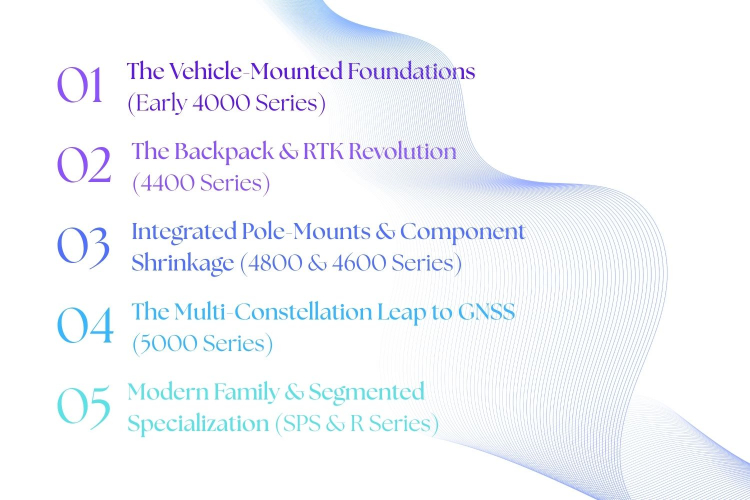
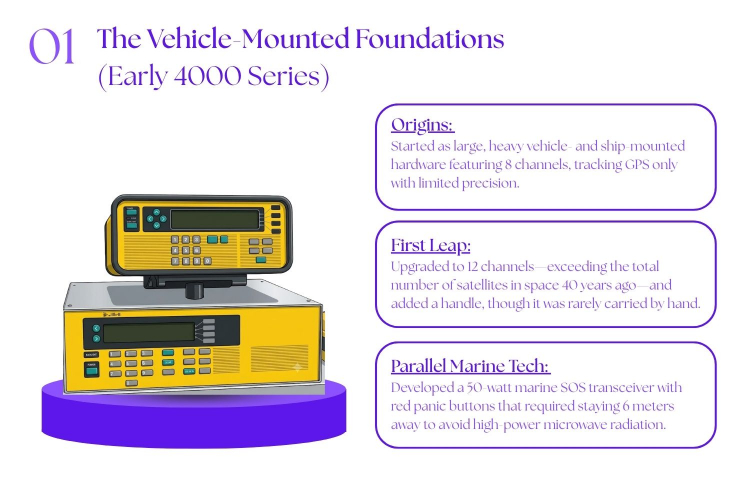
The journey began with the Trimble 4000 Series, which consisted of large receivers mounted on vehicles or ships. It supported only GPS, and it had a limited number of channels compared to modern standards.
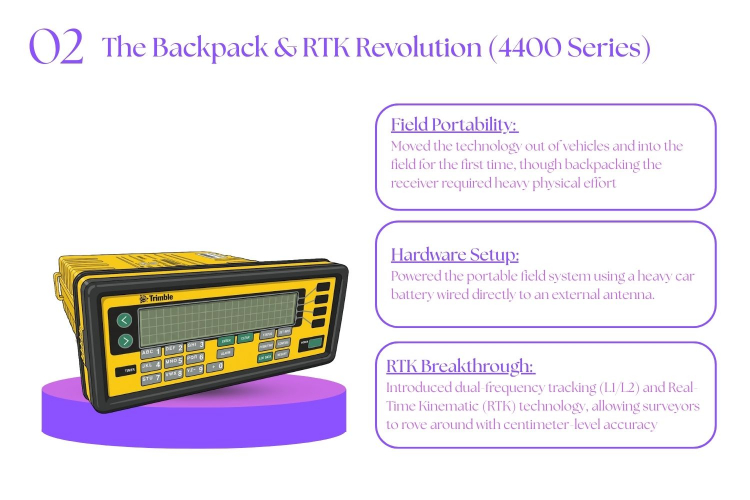
A major milestone was reached with the 4400 Series, making receivers portable for field operations. This era introduced L1/L2 Dual Frequency and RTK Technologies, elevating surveying to centimeter-level accuracy and reducing the time previously required for post-processing.
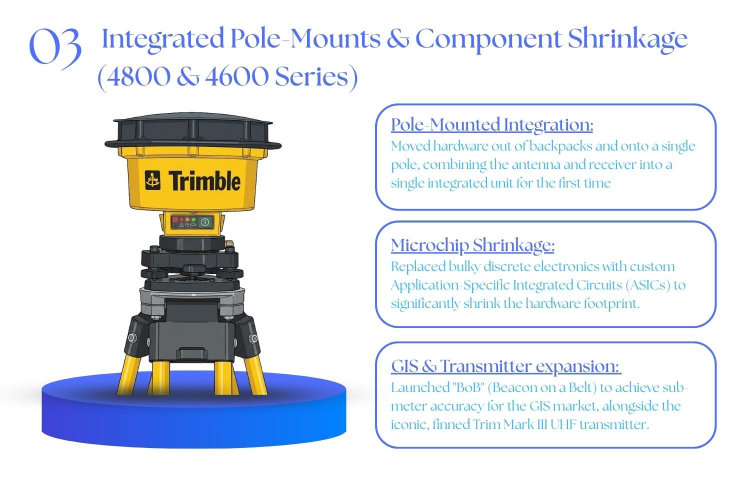
Subsequently, Trimble developed ASIC Technology, significantly reducing receiver size. This led to highly popular models like the 4600 and 4800 Series, which integrated the receiver, antenna, and electronic circuits into a single unit. The company also expanded into the GIS market with the BoB (Beacon on a Belt) device, offering sub-meter accuracy.
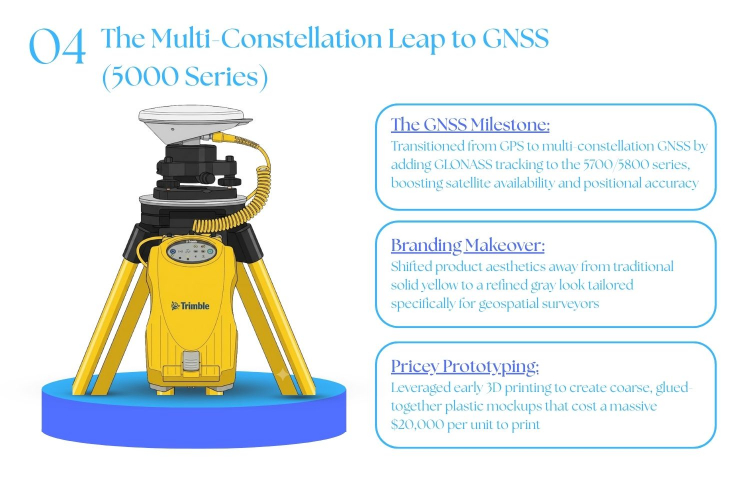
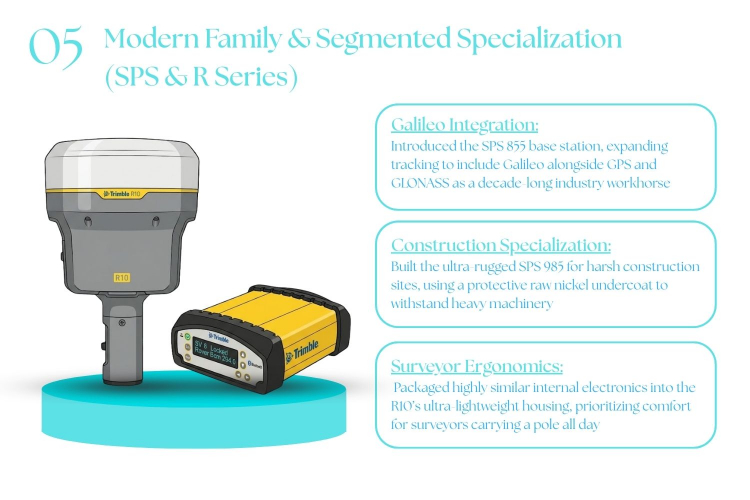
Entering the era of the 5000 Series, Trimble added support for the GLONASS Satellite System alongside GPS, increasing the number of trackable satellites and improving performance in obstructed areas. The product lines were then diversified to suit specific applications: the SPS Series for rugged construction environments and the R Series for surveying tasks that prioritize agility and ergonomic design.
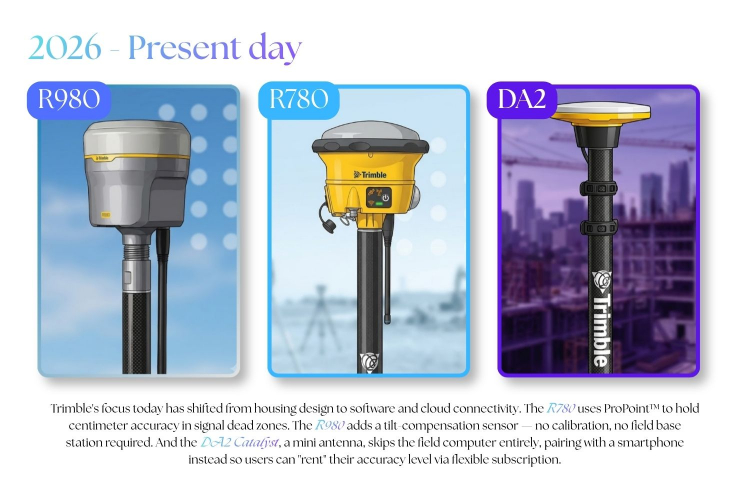
Today, Trimble's strength lies not only in its hardware but also in its software and advanced processing technologies, such as Trimble ProPoint™, TIP™ Tilt Compensation, and CenterPoint® RTX. These innovations enable centimeter-level surveying accuracy even in challenging environments where signal reception is difficult, often eliminating the need to set up a local base station.
Another compelling innovation is the Trimble DA2 Catalyst, which transforms a smartphone into a high-precision surveying instrument. Users can select their desired accuracy level based on the task—from general mapping to centimeter-level surveying—through a flexible subscription model tailored for the digital age.
From the bulky receivers of the past to today’s intelligent, cloud-connected solutions that seamlessly integrate with smartphones, Trimble's evolution reflects a relentless commitment to innovation, continuously elevating the efficiency and accuracy of surveying operations across every era.
The journey began with the Trimble 4000 Series, which consisted of large receivers mounted on vehicles or ships. It supported only GPS, and it had a limited number of channels compared to modern standards.
A major milestone was reached with the 4400 Series, making receivers portable for field operations. This era introduced L1/L2 Dual Frequency and RTK Technologies, elevating surveying to centimeter-level accuracy and reducing the time previously required for post-processing.
Subsequently, Trimble developed ASIC Technology, significantly reducing receiver size. This led to highly popular models like the 4600 and 4800 Series, which integrated the receiver, antenna, and electronic circuits into a single unit. The company also expanded into the GIS market with the BoB (Beacon on a Belt) device, offering sub-meter accuracy.
Entering the era of the 5000 Series, Trimble added support for the GLONASS Satellite System alongside GPS, increasing the number of trackable satellites and improving performance in obstructed areas. The product lines were then diversified to suit specific applications: the SPS Series for rugged construction environments and the R Series for surveying tasks that prioritize agility and ergonomic design.
Today, Trimble's strength lies not only in its hardware but also in its software and advanced processing technologies, such as Trimble ProPoint™, TIP™ Tilt Compensation, and CenterPoint® RTX. These innovations enable centimeter-level surveying accuracy even in challenging environments where signal reception is difficult, often eliminating the need to set up a local base station.
Another compelling innovation is the Trimble DA2 Catalyst, which transforms a smartphone into a high-precision surveying instrument. Users can select their desired accuracy level based on the task—from general mapping to centimeter-level surveying—through a flexible subscription model tailored for the digital age.
From the bulky receivers of the past to today’s intelligent, cloud-connected solutions that seamlessly integrate with smartphones, Trimble's evolution reflects a relentless commitment to innovation, continuously elevating the efficiency and accuracy of surveying operations across every era.